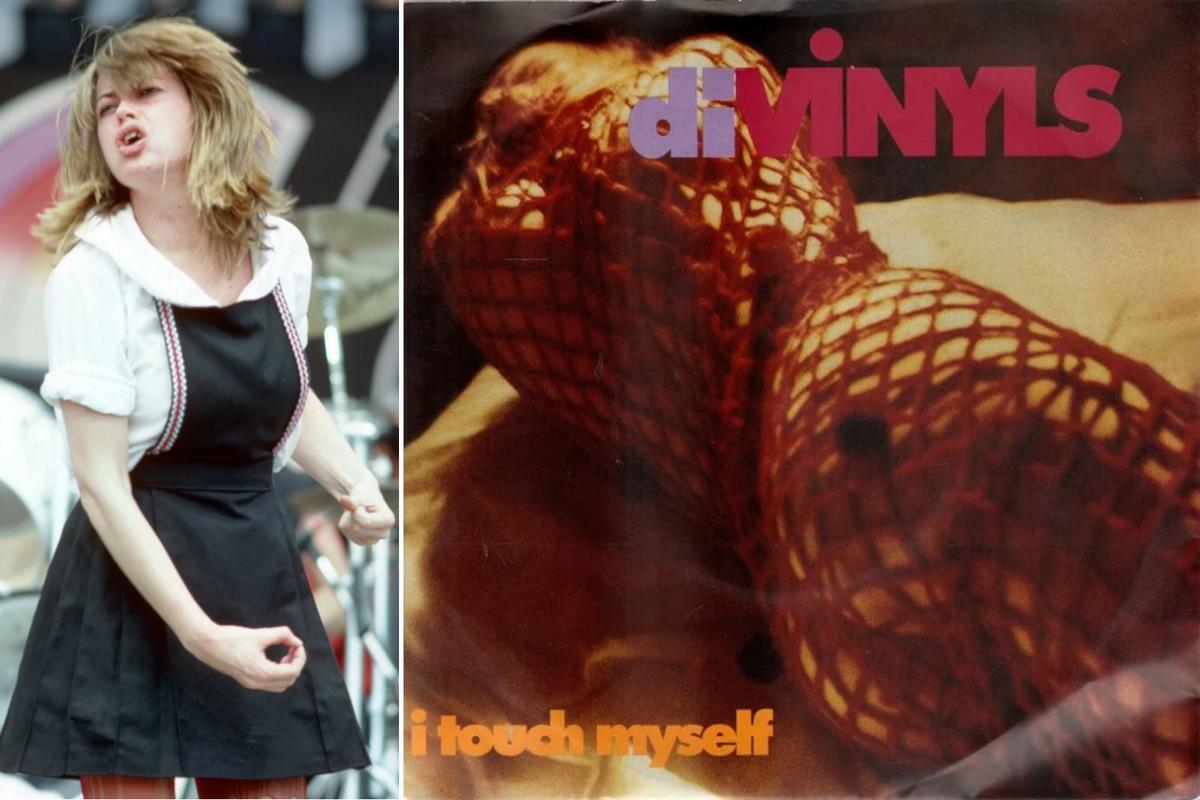

Australian pop rock group the Divinyls scored a massive yet controversial hit with their masturbation-themed tune “I Touch Myself.”
Released as the lead single from the Divinyls’ 1991 self-titled album, the song explored female self-pleasure like never before. At the time, pop-culture was embracing women’s sexuality in a new way, led by Madonna and her ubiquitous hit “Like a Virgin.” It’s no coincidence that the Divinyls’ singer Chrissy Amphlett and guitarist Mark McEntee collaborated with “Like a Virgin” songwriting team Tom Kelly and Billy Steinberg to create their own sexually-charged hit.
“I got together with [Amphlett] and I had a notebook and I had a lot of lyrics that I’d been accumulating,” Steinberg recalled to SongFacts. “I wanted to see which ones she responded to so I nervously pulled out my notebook and allowed her to look through these lyrics. I say nervously because I feel really nervous and self-conscious when someone’s reading my notebooks. I had ‘I Touch Myself’ in there, I had written the first verse and the chorus lyric and that’s the one she liked best.”
‘I Touch Myself’ Was ‘Not Just One-Dimensional’
Amphlett had a reputation for subverting expectations. Inspired by fellow Aussie rockers AC/DC, the singer often wore stockings and a school uniform onstage during Divinyls performances. Her style was both empowering and enticing all at once — and “I Touch Myself” fit that persona like a glove.
READ MORE: 20 Classic Guilty Pleasure Songs From the ’90s
“Really, it was about being touched from the heart, from the soul,” Amphlett noted to the Washington Post in 1991, explaining the song’s layered meanings. “We just discovered it was one of those ambiguous titles that work both ways, you know. And we took it from there. We worked it.”
“But I like that double-entendre thing,” she continued. “Because then the song lends itself to interpretation. It’s playful, it’s not just one-dimensional.”
Chrissy Amphlett onstage with Divinyls in 1991. Donna Santisi, Getty Images
Indeed, the shock value of the track’s title and chorus distracted from its deeper lyrics, which focused on desire, romance and the need to be loved.
“It’s not an obvious start to finish jack off song,” Steinberg pointed out. “I like playing with words, and whether it’s ‘Like a Virgin’ or ‘I Touch Myself,’ I like taking phrases or words that are sort of untapped and find a way to write something meaningful and that has a rebelliousness because really that’s what rock’s all about. Talking ’bout my generation, you know.”
READ MORE: 25 Classic Songs You May Not Realize Are About Sex
Released as a single in late 1990, “I Touch Myself” steadily climbed up the charts, eventually peaking at No. 4 on the Billboard Hot 100. Its popularity helped Divinyls (released Jan. 29, 1991) reach gold sales in the U.S. Meanwhile, the song’s music video — directed by a pre-fame Michael Bay — earned heavy rotation on MTV.
Enduring Legacy of Divinyls’ ‘I Touch Myself’
The Divinyls were never able to match the commercial success of “I Touch Myself” and eventually broke up in 1996. They’d later embark on a successful reunion tour across Australia in 2007. Meanwhile, “I Touch Myself” remained a distinctive hit, used frequently in TV and movies, including a memorable scene in Austin Powers: International Man of Mystery.
Amphlett died of breast cancer in 2013. Prior to her passing, the singer wanted “I Touch Myself” to be adopted as an anthem for breast health. A year later, the I Touch Myself Project was officially launched in her memory, dedicated to education and resources to promote self-examination.