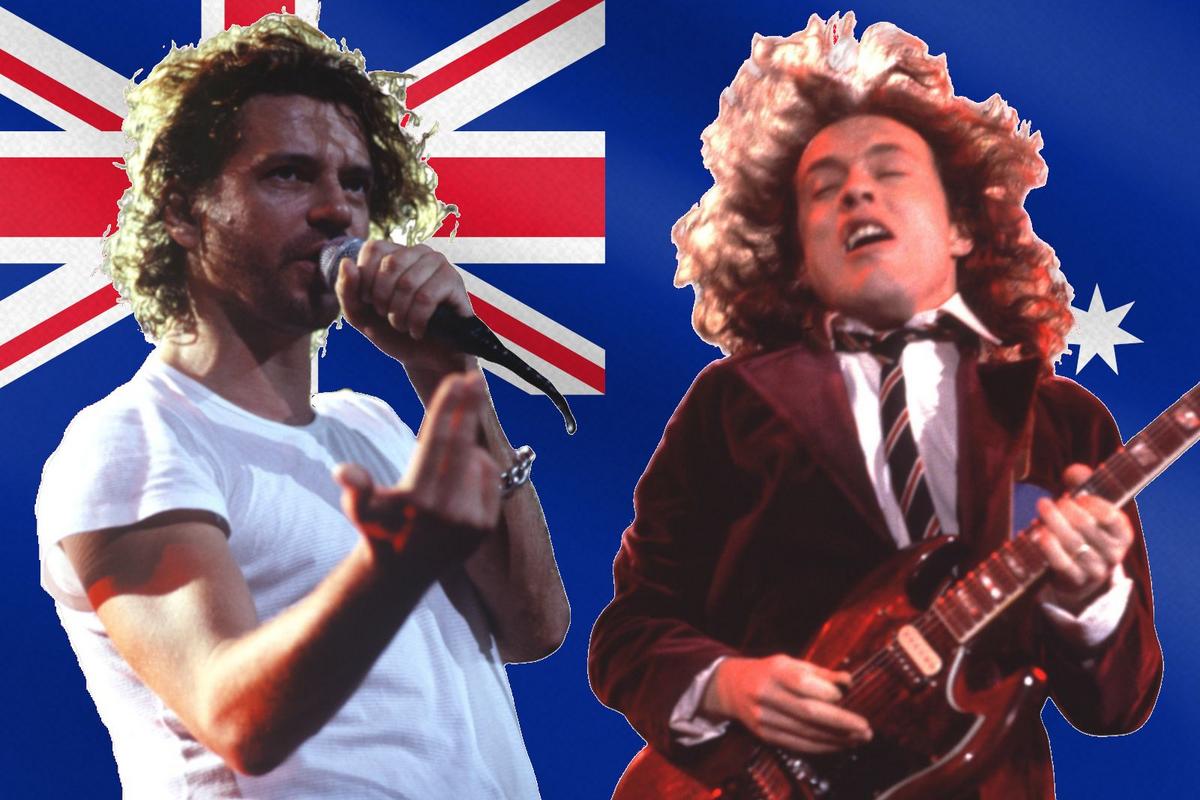

Australia boasts a rich rock history — but picking the country’s Big 4 is no mean feat.
At the dawn of rock, most Down Under artists covered popular tunes made famous by English and American bands. However, soon Australia’s musicians sought to blaze their own trail, and by the late ’70s, Aussie acts were breaking out with their own original material.
Picking Australia’s top band is pretty easy (more on that below), but filling out the rest of their Big 4 is a notably more difficult challenge. Ask Australians to name their favorite group and many will mention Cold Chisel, pub rock legends who enjoy star status in their homeland. However, Cold Chisel never found success beyond Australia’s shores, and if worldwide impact is one of our measurements for judgment (hint: it is), then Cold Chisel doesn’t make the cut.
The ’80s brought worldwide attention to many Australian acts, including Midnight Oil, Air Supply and Men at Work — the latter having created perhaps the most Australian song of all time. But are any of them Big 4 worthy?
READ MORE: Who Are the ‘Big 4’ of Sunset Strip Bands?
What about more recent Aussie success stories, such as Jet, Wolfmother, the Vines and the Living End? Should acts like the Bee Gees and Crowded House be included, even if their origins are technically in other countries (England and New Zealand, respectively). And what about psychedelic-pop rockers Tame Impala, one of the biggest acts of the last decade?
We pondered all of these considerations and more, then came up with our Big 4 of Australian Rock Bands below.
Atlantic Records/Michael Ochs Archives, Getty Images
AC/DC
The easiest decision in this whole process was the inclusion of AC/DC, a band that sits firmly atop the mountain of Australia’s greatest acts thanks to an incredible legacy of hard rock dominance.
Since emerging from Sydney’s local music scene in the early ‘70s, Acca Dacca (as they are affectionately called in their home country) has blazed a trail all their own. The numbers speak for themselves: More than 200 million albums sold worldwide, thousands of concerts around the globe, the second best-selling album of all time (Back in Black) and a career spanning over 50 years. But the group’s impact goes far beyond sales achievements – even if those statistics are damn impressive.
AC/DC forever altered the trajectory of hard rock, influencing generations of musicians who have followed in their footsteps. Their muscular guitar driven onslaught is unmatched, along with a distinctive penchant for the kinds of lyrics that inspire fists to be thrown in the air. The list of timeless tracks is long and impressive, including “Highway to Hell,” “Back in Black, “You Shook Me All Night Long” and “Thunderstruck.” Throw in a Rock & Roll Hall of Fame induction, along with a well-earned reputation as one of rock’s most sensational live acts, and you have all the makings of an iconic band.
Fryderyk Gabowicz/picture alliance, Getty Images
INXS
The band that would become INXS formed in Sydney in 1977, but it took a while for them to find their footing. Besides going through name changes – they were known as the Farriss Brothers and (briefly) the Vegetables before landing on their now-famous moniker – the band also searched to find their sound. Early recordings were more pop-leaning, through the group soon began embracing a darker, new wave style.
After their first two albums earned some attention in Australia, INXS began spreading worldwide with 1982’s Shabooh Shoobah. The LP landed them their first U.S. hits with “The One Thing” and “Don’t Change.” In the years that followed, INXS would deliver further classics, including “Original Sin” and “What You Need.” Then came the 1987 explosion known as Kick, a dynamic and engrossing LP that cemented INXS among the world’s biggest acts. With hits like “Need You Tonight,” “New Sensation,” “Devil Inside” and “Never Tear Us Apart,” Kick emerged as one of the defining albums of the ’80s.
Things may have waned in the ‘90s, and the death of singer Michael Hutchence – one of the most electrifying frontmen of his generation – brought the band’s classic era to a tragic close. Still, at their height, few could rival INXS.
Frans Schellekens/Redferns, Getty Images
Nick Cave and the Bad Seeds
Nick Cave initially came onto people’s radar in the early ‘80s via his band the Birthday Party, which scored a few moderate hits in the U.K. and Australia. Cave’s distinctive voice and darkly poetic songwriting captivated audiences, and when the Birthday Party disbanded in 1983, he transferred that momentum into his new group, Nick Cave and the Bad Seeds.
Mixing a variety of influences ranging from post-punk, to blues and art rock, the band has continually been difficult to pigeonhole – and that’s just how Cave likes it. Across 18 studio albums, they’ve delivered everything from hauntingly morose ballads to energy filled anthems. Through it all, Cave’s calling card has always remained the same: intellectual, deeply engrossing lyrics, along with unbridled raw emotion.
You may not hear Nick Cave and the Bad Seeds on commercial radio, and they’ve never scored a mainstream hit. Their most famous song, “Red Right Hand,” has taken a life of its own thanks to an endless array of covers and placements in TV and films. But Cave and his band earn their place among Australia’s Big 4 thanks to the massive impact they’ve had on other artists. Arctic Monkeys, Queens of the Stone Age, Modest Mouse, the National and Florence + the Machine are among the many acts who have been influenced by Cave’s work.
Mick Hutson/Redferns, Getty Images
Silverchair
We struggled with who deserved Australia’s final Big 4 slot, but ultimately landed on alt rock pioneers Silverchair. When the trio’s members were just teenagers, they burst onto the world’s stage via their 1995 debut album Frogstomp. Recorded in just nine days, it offered Australia’s answer to the grunge revolution, with a sound that echoed acts like Nirvana and Pearl Jam, yet still felt distinctive.
Singer Daniel Johns, drummer Ben Gillies and bassist Chris Joannou crafted an LP far more mature than their ages. “Israel’s Son” was sludgy, dark and hypnotic, while “Pure Massacre” was a pointed criticism of war. Still, the breakout song was “Tomorrow,” an enthralling track that reached No. 1 in both hemispheres (Australia and the U.S.A.). If that was where the story ended, Silverchair would only be on our Big 4 bubble. However, they followed the multiplatinum success of Frogstomp with Freak Show (1997) and Neon Ballroom (1999), both of which earned further commercial success and acclaim.
In 2011, the band announced an “indefinite hibernation,” one they haven’t woken up from (and perhaps never will). Still, they remain one of Australia’s most impactful rock acts, having shaped many of the country’s artists who followed. One such example, Tame Impala’s Kevin Parker, who has admitted to being “obsessed” with Silverchair and once claimed their music “might be responsible for me wanting to be in a rock band at all.”
’80s Australian Invasion
A look at the impact Australian musicians, actors, filmmakers and companies had on American pop culture in the ’80s.
Gallery Credit: Corey Irwin