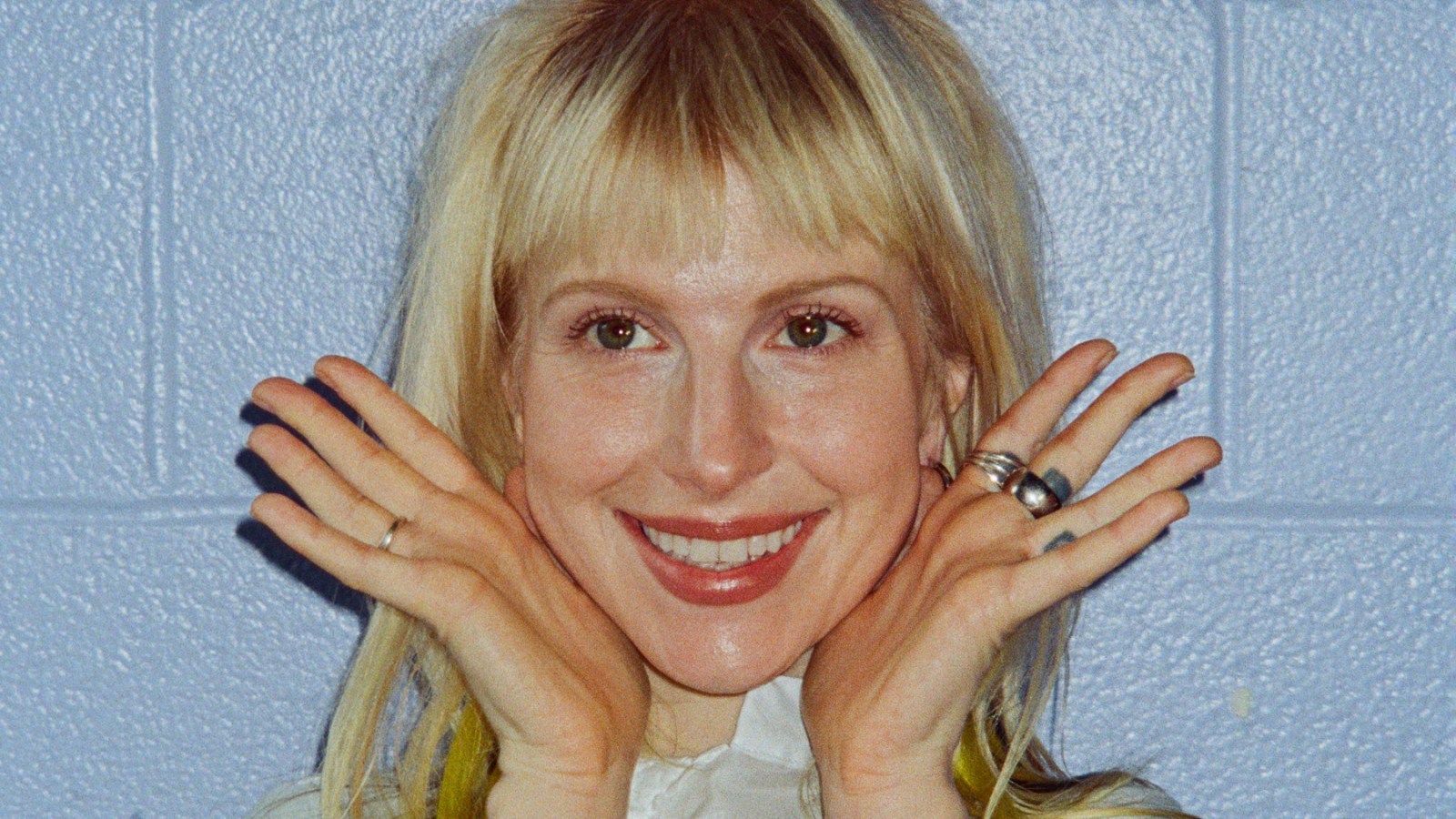

There was a challenge in the tone Hayley Williams took onstage at New York’s Forest Hills Stadium on Sept. 16. “You think you know me?” she asked on “Pure Love,” a glinting funk record from her debut solo album, Petals for Armor. “Wait til I open up to you.” It takes a level of intimacy, understanding, and time to really know someone. How do you distill such an undertaking in just under two hours? What’s too essential to be left out? On this tour, Williams works to find answers across 25 songs.
Early in the set, Williams raged through “Simmer” as lights pulsated to the beat of dark and sinister bass lines. They quickened in pace until the song reached an explosive peak and the words “The Hayley Williams Show” flashed onto the white curtains draped around the stage. During “Creepin,” there were giant eyes broadcast on the fabric, some with freakishly long lashes and others that multiplied to create an unsettled sense of surveillance. This sense of urgency never dissipates during the show. It isn’t always panicked, or even confrontational. Mostly, Williams just seems eager for the crowd to give themselves over to this connection for a little while.
Earlier this year, Williams spent three months performing in smaller rooms on the Hayley Williams at a Bachelorette Party Tour. She felt an insatiable hunger to spend her time “gorging on future memories while they’re hot and ready” and “practicing hyper-presence,” as she wrote online in May. Her album Ego Death at a Bachelorette Party had arrived just a few months before the run of shows began, and the songs were still new and finding their form in a live setting. They still felt like breakthroughs and fresh wounds.
Ego Death wasn’t the first time that Williams tore herself apart and pulled herself back together through song. But it afforded her the first opportunity to exorcise that emotional experience on a stage. Petals for Armor arrived a few weeks into pandemic lockdowns. There was a twisted irony in the internal confrontation required to make a record like that, mirroring the exhausting amount of time we were all made to spend with ourselves back then. The songs from that record are six years old now, but too new to the stage to be approached from a place of complete rest and recovery. They still bleed, too.
Williams kept the respective songs from each album close together, grouping them in three- and four-track clusters. The thunderous “Cinnamon” and “Dead Horse” with “Pure Love” and “Crystal Clear,” smoky selections brimming with devotion. In the studio version of “Crystal Clear,” there’s an airy space left after Williams sings, “We don’t know how this could end, let’s hope it won’t have to.” The live arrangement replaces the quiet with an overload of bass and percussion. It almost feels like a different song created from the perspective of knowing now what she didn’t then. Her findings are what informed so much of Ego Death, like the subsequent run of “Glum” and “Disappearing Man” into “Dream Girl in Shibuya” and “Good Ol’ Days.”
There’s only one song on the set list from Flowers for Vases / Descansos, the album Williams recorded at home in Nashville in 2020. “Just a Lover” opens and closes the pre-encore portion of the set. The first go around, Williams is alone onstage at her piano. “Love has turned me into many others, now I guess I’m just/Just a lover,” she sings. She doesn’t reach the end of the song. Instead, she welcomes her six-piece band to the stage, most of whose members toured with Paramore during their This Is Why run. When she returns to “Just a Lover” more than an hour later, the space is even more crowded with the addition of the True Believer Quartet for the first time on the tour.
The four-piece string ensemble previously joined Williams for a chilling performance of the Ego Death deep cut “True Believer” on The Tonight Show last year. On tour, they recreated that rendition sans gospel choir, but complete with an interpolation of Billie Holiday’s “Strange Fruit.” Forest Hills fell silent during the song, with the exception of an astonished “damn” here and there. The context of the record, about the ghosts left in the wake of American sins, is gripping enough, but Williams’ voice cut through with staggering precision. For an artist who has been refining their vocal instrument for years now, it’s hair-raising to watch her learn new ways to wield it.
Williams combined “True Believer” with an abridged cover of Nina Simone’s “Don’t Let Me Be Misunderstood,” a song that pleads for the goodness of a soul to still be visible through the clouds of worry or anger. There’s more than enough anger to go around, but most of it is built on the foundation of hope that any attempts to find the right words don’t fall on deaf ears. This is one of the show’s most important moments, largely because it takes the foundation Williams established with her own revelatory writing and builds on it with music that has shaped her, or taught her something about herself, in the same way her music has for the audience spread out in front of her.
Just before the show began, Williams loaded up her pre-show playlist with six songs that speak to this musical conversation. The run started with Macklemore’s “Can’t Hold Us” and closed with “Thrift Shop,” two songs the rapper performed during his opening set on Ed Sheeran’s tour before being removed for voicing his support for Palestinians on stage. In between, Forest Hills filled with songs from Lukas Graham, Finneas, Aaron Rowe, and Boega, the supporting acts who withdrew from Sheeran’s tour in solidarity.
Some might have heard Williams scream “Fuck ICE” and “Free Palestine” into the mic during “Ice in My OJ” earlier in the set and assumed it was a response to this week’s headlines. But the chants have been a staple in her performances since the Ego Death tour began earlier this year, just like her pre-”True Believer” declaration that “the greatest threat to American democracy is Christian nationalism.” At a time when one of the biggest acts in music is arguing that his shows are not a political forum, but instead a place of safety and sanctuary, the resounding cheers that ring out in response to statements like these are a transparent reminder that they can, in fact, be the same thing.
When Williams dedicates “Ego Death at a Bachelorette Party” to Nashville, it’s because she recognizes how this dichotomy haunts the streets there. Her love for the city is inseparable from the forces — whether racist country singers or tourists and displacement — responsible for dismantling and restructuring everything in the memories that keep her tethered there. There’s a version of this happening in every city she performs in. It waits just outside the gates of each venue. It’s part of why these audiences need these shows as much as they do.
“Thank you for leaving your house and getting together with a bunch of strangers to scream, and sweat, and dance,” Williams said towards the end of the set. “I hope we always fight for this sort of thing. It should be a lot more available and readily accessible to you. It should not be so hard to go to live concerts. I’ll see you next time. Until then, please take care of you. Take care of each other — and for fuck’s sake, let’s vote in November.”
Williams pressed against the confines of knowing herself and being known in this show. She sang about overcoming an instinct to suppress femininity on “Hard,” then moments later had her face painted in gold glitter in the middle of “My Friend.” The crowd leaned in, too, illuminating the open-air venue with flashlights on an extra cloudy night in a place where it’s already almost impossible to see stars, even when the skies are clear. It’s a connection build on head banging, hard truths, and pure love. It’s the Hayley Williams Show.